Many people feel a quiet pull toward something deeper.
They may not know what to call it yet. They may say, “I believe in something greater,” or “I feel connected in nature,” or “I pray, but I do not feel drawn to organized religion.”
Others may belong to a religion and deeply value their faith. They may find strength through prayer, community, scripture, ritual, and tradition.
Both paths can be meaningful.
The question is not always, “Which one is right?”
A more helpful question may be, “What helps me feel connected, guided, compassionate, and aligned?”
Caroline Myss has spent much of her work exploring the connection between energy, spirit, personal power, healing, and sacred truth. In Anatomy of the Spirit, she connects Hindu chakras, Christian sacraments, and the Kabbalah’s Tree of Life into a model of spiritual growth and energetic awareness. Her work reminds us that spiritual development can appear across traditions, not only inside one system.
What Is Religion?
Religion often includes shared beliefs, sacred texts, rituals, moral teachings, prayer, worship, and community.
For many people, religion gives life structure. It can offer comfort during grief. It can create belonging. It may help a person understand right and wrong, suffering, forgiveness, service, and devotion.
Georgetown University’s National Center for Cultural Competence describes religion as an organized system of beliefs and practices, often shared within a community. It also notes that religion can become a platform for spiritual expression.
This is important.
Religion does not have to block spirituality. At its best, religion can help spirituality grow.
A person can attend church, temple, mosque, synagogue, or another sacred gathering and feel deeply connected to God, Source, love, or divine wisdom.
The challenge comes when religious practice becomes only external.
Caroline Myss often brings attention to personal integrity, inner truth, and the way we use our power. A person can follow religious rituals, yet still avoid inner reflection. Another person may never enter a formal place of worship, yet live with deep reverence.
Spiritual maturity asks us to look within.
What Is Spirituality?
Spirituality is often more personal.
It may include prayer, meditation, nature, creativity, intuition, silence, compassion, forgiveness, gratitude, and service.
The University of Minnesota’s Earl E. Bakken Center for Spirituality & Healing describes spirituality as the way people seek meaning, purpose, and connection with the moment, self, others, nature, and the sacred. It also explains that spirituality and religion overlap, but they are not identical.
Spirituality asks questions like:
“What gives my life meaning?”
“How do I connect to something greater?”
“How can I live with more love?”
“What is this situation teaching me?”
“What part of me needs healing?”
Spirituality may help a person feel guided from within. It may also help them notice patterns, emotions, choices, and beliefs that shape their life.
This matters because spirituality is not only about peaceful moments.
It can also ask us to become honest.
The Overlap Between Spirituality and Religion
Spirituality and religion can overlap beautifully.
A religious person may feel spiritual through prayer, scripture, service, sacred music, or ritual.
A spiritual person may feel connected through meditation, nature, energy work, creativity, or quiet reflection.
Neither path needs to compete with the other.
Georgetown’s discussion of spirituality and religion notes that spirituality is often seen as broader. It may include religion for some people, while standing alone for others. It also states that no value judgment needs to sit between the two.
This is the compassionate place to begin.
Some people heal through their faith tradition.
Some people heal after stepping outside religious structures.
Some people return to religion with a more open heart.
Some people create a spiritual life that feels more personal and less formal.
What matters most is whether the path helps you become more loving, truthful, grounded, compassionate, and awake.
Caroline Myss: Spirituality as Personal Power and Sacred Responsibility
Caroline Myss’s work often points us toward the connection between spirit, choice, energy, and personal power.
In Anatomy of the Spirit, Myss presents the body’s seven spiritual and physical power centers. She connects these centers with universal lessons of consciousness, maturity, and healing. Her model draws from the chakras, Christian sacraments, and Kabbalah.
This matters for a blog about spirituality and religion.
Myss does not present spirituality as something vague or passive. She presents it as a path of responsibility.
Spiritual growth asks:
“Where am I giving my power away?”
“What truth am I avoiding?”
“What old wound still defines me?”
“Where do I need forgiveness?”
“What belief keeps me separate from love?”
These questions can help both religious and nonreligious people.
A person inside a religion may use these questions to deepen their faith.
A person outside religion may use them to deepen their connection to the sacred.
Either way, spirituality becomes embodied.
It becomes how you speak, choose, forgive, listen, serve, and live.
What Research Says About Spirituality, Religion, and Well-Being
Research on spirituality and religion continues to grow.
A 2021 review in Brazilian Journal of Psychiatry looked at spirituality, religiousness, and mental health. The authors noted that research in this field has expanded over recent decades. Many studies now explore connections between spirituality, religious involvement, coping, depression, anxiety, substance use, and other areas of mental health.
A major review by Harold Koenig in ISRN Psychiatry summarized research on religion, spirituality, and health. It discussed links with mental health, social support, meaning, coping, and physical health outcomes. The paper also noted that spiritual and religious beliefs may influence health behaviors and resilience.
Another review on religiosity, spirituality, and physiological markers suggested that spiritual or religious involvement may benefit health partly by reducing the disruptive effects of stress and depression on inflammation.
This does not mean spirituality “cures” health conditions.
It means that meaning, connection, emotional support, reverence, compassion, and spiritual coping may support the whole person.
That is a beautiful distinction.
Spirituality may not remove every challenge.
Yet it may help you meet life with more courage, presence, and inner steadiness.
If You Are More Spiritual Than Religious
Many people now describe themselves as spiritual, but not religious.
This can happen for many reasons.
Some people grew up in a religion but felt judged, limited, or disconnected.
Some still believe in God, but not in religious institutions.
Some feel closer to the sacred in nature than in a building.
Some feel drawn to energy healing, meditation, intuition, or inner work.
Some simply want direct experience.
This path can feel freeing. It can also feel lonely.
Religion often offers community. Spirituality can become isolated without intention.
So, if you feel more spiritual than religious, consider creating your own rhythm.
You may not need a formal religion to have a sacred life.
But you may need devotion, practice, honesty, and consistency.
Spirituality grows when we give it space.
My Own Journey: Rebuilding Spirituality After Religious Loss
For me, this topic is deeply personal.
I spent more than 36 years inside a devout religious community. It shaped my family life, friendships, beliefs, identity, routines, and sense of belonging. For a long time, it was not just something I attended. It was the world I knew.
When a family member was excommunicated, also known in some faith communities as being disfellowshipped, I experienced a painful separation within my family and community. A choice I made (leaving the religion), knowing the consequences it would bring. Over time, I had to move through grief, confusion, fear, trauma, anger, sadness, and the deep ache of losing connection with people I loved, including my own parents.
Leaving that world did not mean I stopped caring about God, truth, love, or living with integrity.
In many ways, it asked me to rebuild my spiritual life from the inside out.
I had to ask deeper questions. What do I truly believe? Where do I feel connected to the sacred? How do I separate fear from faith? How do I honor my own healing while still holding compassion for others who choose a different path?
This is why I hold this conversation with great care.
I know that religion can bring comfort, structure, devotion, and community. I also know that religious loss can create real emotional pain, especially when family bonds and belonging are affected.
My intention is not to tell anyone what to believe.
My hope is to create a space where you can gently explore what helps you feel connected, guided, loving, grounded, and spiritually whole.
If you have experienced religious loss, spiritual confusion, family separation, or community rejection, please know this: your spiritual life is not over.
It may simply be asking to become more honest, more personal, and more rooted in love.
You can grieve what was lost and still build something sacred.
You can honor what helped you and release what harmed you.
You can respect someone else’s faith and still choose a path that supports your healing.
If You Are Religious and Want to Deepen Spiritually
If you belong to a religion, spirituality can help you move deeper into your faith.
It can help prayer feel more honest.
It can help ritual feel more embodied.
It can help scripture feel more alive.
It can help service come from love, not obligation.
You do not have to leave your religion to become more spiritual.
You may simply begin asking deeper questions.
“Am I practicing this from love or fear?”
“Does this belief help me become more compassionate?”
“Where do I feel separated from God, myself, or others?”
“What wound am I bringing into my faith?”
“What part of me needs grace?”
This is where spirituality can soften rigid thinking.
It can bring the heart back into practice.
How Trapped Emotions and Beliefs May Hinder Spirituality
Many people want to feel spiritually connected, but something blocks them.
They may say:
“I cannot quiet my mind.”
“I do not trust my intuition.”
“I feel disconnected from God.”
“I want to forgive, but I cannot.”
“I feel numb when I pray or meditate.”
“I keep repeating the same emotional patterns.”
This does not mean they lack faith.
It may mean old emotions, imbalances, or subconscious beliefs are creating resistance.
In energy healing, we look at the body as more than physical. We also consider emotional, energetic, and subconscious patterns.
A trapped emotion may keep someone guarded.
An energetic imbalance may leave someone feeling unsettled.
A deep-rooted belief may whisper, “I am not safe,” “I am not worthy,” or “I cannot trust myself.”
These patterns may affect how open someone feels to love, guidance, intuition, and spiritual connection.
How The Emotion Code, The Body Code, and The Belief Code May Support Spiritual Growth
The services I offer may help you explore what sits beneath the surface.
The Emotion Code® may help locate and release trapped emotions. These emotions may relate to grief, resentment, fear, abandonment, shame, or heartbreak.
The Body Code™ takes a broader look at energetic imbalances in the body. This may include emotional, energetic, structural, nutritional, toxic, or other imbalance categories.
The Belief Code® may help identify deep-rooted belief systems. These beliefs may influence how safe, worthy, connected, or spiritually open you feel.
All three methods use muscle testing to communicate with the subconscious mind.
This process may help reveal patterns that the conscious mind cannot easily access.
For someone spiritual, this work may support a deeper connection to intuition.
For someone religious, it may support a deeper connection to prayer, trust, surrender, and grace.
This work does not replace religion, therapy, or medical care.
It can support self-awareness and personal growth.
Helpful Tools to Become More Spiritual
1. Begin with One Honest Question
Ask yourself one question each morning.
“What does my soul need today?”
Do not force an answer.
Listen gently.
2. Create a Daily Sacred Pause
Take three quiet minutes.
Place your hand over your heart.
Breathe slowly.
Say, “I am willing to listen.”
3. Practice Gratitude With Specificity
Do not only say, “I am grateful.”
Name one small thing.
“I am grateful for the light on the trees.”
“I am grateful for my warm tea.”
“I am grateful that I noticed my emotions today.”
Specific gratitude builds presence.
4. Notice Where You Lose Power
This is very aligned with Caroline Myss’s teachings.
Ask, “Where did I give my power away today?”
Then ask, “What choice would bring me back to myself?”
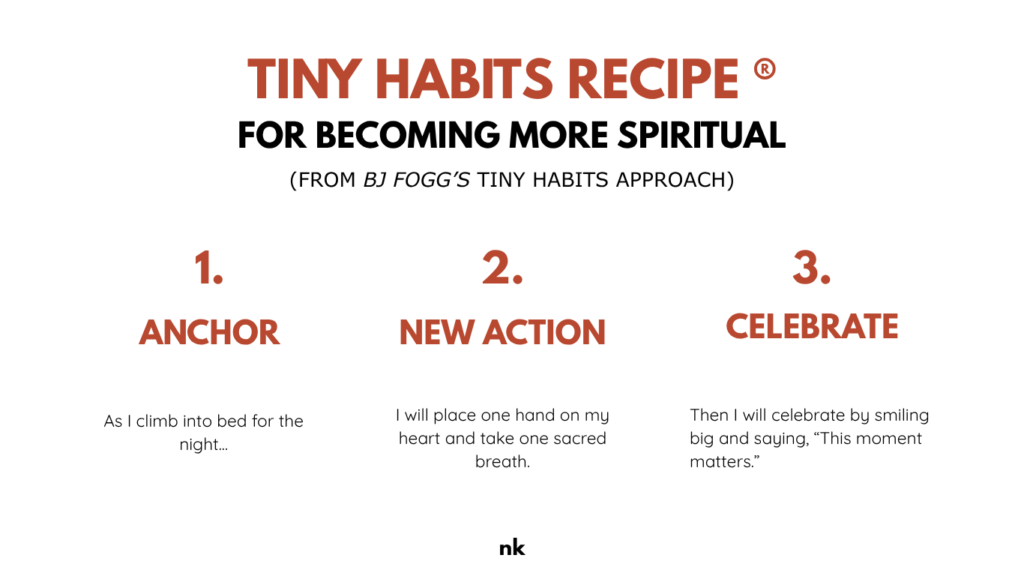
5. Use a Tiny Habits Recipe
As I climb into bed for the night, I will place one hand on my heart and take one sacred breath. Then I will celebrate by smiling big and saying, “This moment matters.”
Small practices create spiritual rhythm.
6. Spend Time in Nature
Nature often quiets the personality.
It can help you feel connected without needing words.
7. Journal Without Editing
Write for five minutes.
Start with: “What I am ready to understand is…”
Let your deeper wisdom speak.
A Gentle Closing Reflection
Spirituality and religion do not need to stand against each other.
Religion may give you tradition, community, structure, and sacred language.
Spirituality may help you experience meaning, connection, intuition, and inner truth.
For some people, they work together.
For others, spirituality becomes a more personal path.
Caroline Myss’s work reminds us that spiritual growth asks for honesty, responsibility, and the wise use of personal power. It asks us to notice where our wounds, beliefs, and fears still shape our choices.
Energy healing may help you explore those deeper patterns.
Through The Emotion Code®, The Body Code™, and The Belief Code®, we can gently ask what may be standing between you and a fuller connection to yourself, your intuition, your faith, or the sacred.
You do not have to have every answer.
You only need a willing heart.
Your spiritual path can begin with one breath, one honest question, and one loving choice.
XO!
Nico’l